What Do Your Work Tools Really Cost? The Math Every Small Business Should Do
•
Business
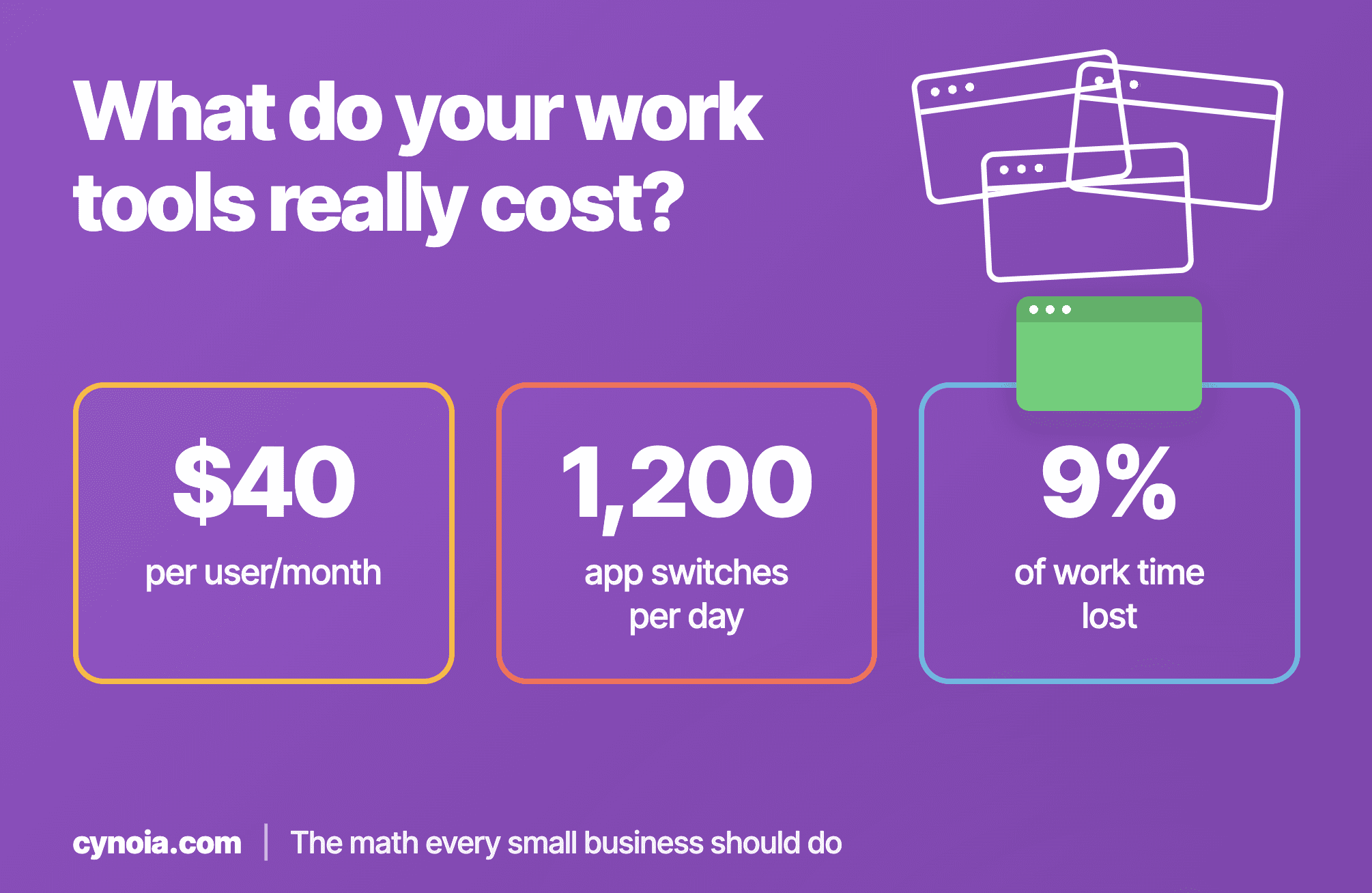
The real cost of your collaboration tools never shows up on an invoice. Between stacking subscriptions, the hours your team loses jumping from app to app, and — for African businesses — paying in foreign currency, a 20-person team can quietly spend the equivalent of a full annual salary without ever deciding to.
At Cynoia, we help more than 6,000 users across Africa and Europe consolidate their work tools. Our first piece of advice is always the same: do the math. Here it is, step by step.
Quick Answer
A 20-person team running a typical stack — team messaging, video calls, project management, office suite — pays about $9,600 per year in subscriptions at June 2026 list prices. The hidden cost is bigger: research published in Harvard Business Review found that employees toggle between apps nearly 1,200 times a day — roughly 4 hours per week, or about 9% of annual work time, spent just reorienting.
Quick formula: true cost ≈ annual subscriptions + (headcount × average salary × 9%) + FX and admin fees. In most small businesses, the total far exceeds the "software" line in the budget.
1. What Is SaaS Sprawl?
SaaS sprawl (or tool sprawl) is the unchecked multiplication of software inside a company. One app for chat, another for video meetings, a third for tasks, a fourth for files, a fifth for the calendar. Each was adopted for a good reason; it's the accumulation that hurts.
And it's not just an enterprise problem: companies with 75 to 200 employees use an average of 44 SaaS applications. While large enterprises have started consolidating — the average app portfolio has shrunk 18% since its 2022 peak, according to the Zylo SaaS Management Index — small businesses keep stacking, mostly because nobody has time to audit.
2. Cost #1 — Stacking Subscriptions
Here's a stack we see constantly in small businesses, at June 2026 list prices (annual billing):
Slack Pro (team messaging): $7.25 / user / month
Zoom Pro (video meetings): ≈ $13.33 / user / month
Asana Starter (project management): $10.99 / user / month
Google Workspace Business Starter (email, Drive, Calendar): ≈ $7–8.40 / user / month
Total: ≈ $40 / user / month
For a 20-person team, that's about $9,600 a year — and that figure is a floor. It doesn't count seats you pay for but nobody uses, duplicate tools (two video apps, two storage drives), or the forced plan upgrades that hit every time you outgrow a limit.
3. Cost #2 — The Toggle Tax: Time Lost Between Tools
The biggest cost never appears on any bill. Researchers who tracked how employees actually work — in a study published in Harvard Business Review — measured nearly 1,200 app switches per employee per day. Each switch costs only a couple of seconds. Added up, they consume about 4 hours per week — 9% of annual work time — spent not producing, but reorienting.
Apply that ratio to our 20-person team: 9% of 20 employees' time is nearly two full-time positions absorbed every year by simply navigating between tools. Whatever your salary levels, that cost dwarfs the subscriptions.
On top of the toggle tax comes fragmented attention: a question asked in chat, an answer buried in a task comment, a decision made on a video call and never written down. The information exists — nobody knows where.
4. Cost #3 — The Cost Nobody Writes About: Paying in Foreign Currency
This is the blind spot of every analysis published on this topic. For a business in Dakar, Lagos, Nairobi, or Tunis, subscribing to a US software stack means paying in dollars or euros, with three extra costs every founder knows too well:
International payment fees: FX commissions and bank charges on every monthly debit, multiplied by the number of tools.
Exchange-rate exposure: a SaaS budget approved in January can blow up by Q3 as the local currency moves against the dollar.
Payment access constraints: international card limits, rationed foreign currency, bank approvals — administrative friction repeated for every single vendor.
Cutting the number of vendors that bill in foreign currency isn't just a saving; it's a cash-flow simplification. It's one of the reasons Cynoia was built as a single platform, designed in Africa for African and European teams.
5. Cost #4 — The Invisible Costs: Onboarding, Security, Scattered Knowledge
Three more line items complete the bill — rarely quantified, always real:
Multiplied onboarding: every new hire must be created, trained, and configured on 4 or 5 tools. Every departure must be revoked everywhere — and one forgotten account is a security hole.
A wider risk surface: more tools means more passwords, more privacy policies to vet, more company data scattered across vendors. For organizations handling sensitive data, this becomes a deal-breaker in procurement.
Fragmented knowledge: when decision history is split across a messaging app, comment threads, and meeting recordings, every search for information becomes an investigation.
6. The 4-Step Method to Calculate Your Own Cost
List every collaboration subscription (messaging, video, projects, storage, calendar) — including the ones paid on personal cards and expensed. Note the price per seat and the number of seats paid for. Not used. Paid for.
Compute the annual cost in your local currency, FX fees included if you pay in dollars or euros.
Estimate your toggle tax: headcount × average salary × 9%. It's an approximation, but it gives you the order of magnitude of the hidden cost.
Add a "risk and admin" line: HR/IT time spent managing accounts, duplicate tools you've spotted, incidents tied to unrevoked access.
In most of the small businesses we work with, the total is a surprise: the real cost runs several times higher than the subscriptions alone.
7. Cutting the Bill: Consolidate, Don't Stack
The answer to SaaS sprawl isn't to cut what your team does — they genuinely need to chat, meet, plan, and share files. The answer is to group those needs into the smallest possible number of tools.
That's exactly Cynoia's bet: chat, video conferencing, calendar, file sharing, and project management in one platform, one subscription, one invoice — where information stays where it was created. A conversation becomes a task, a meeting links to the project's documents, and nobody spends four hours a week reassembling the puzzle.
For a 20-person team, replacing the stack above with a unified platform means four times fewer vendors, a smaller subscription bill, and a meaningful share of that 9% of lost time recovered. We covered what this means for young teams in how startups save on software costs, and where we're heading in Cynoia V2: from tool overload to intelligent orchestration.
Ready to run the numbers for your team? Try Cynoia free (10 users, no credit card required) or talk to our team — we'll help you price out your current stack, no strings attached.
FAQ
What is SaaS sprawl?
SaaS sprawl is the unchecked multiplication of software across a company: every team adopts its own tools, subscriptions pile up, and information scatters. Companies with 75–200 employees use an average of 44 SaaS applications.
How much does a typical collaboration stack cost a small business?
At June 2026 list prices, a Slack + Zoom + Asana + Google Workspace stack runs about $40 per user per month — roughly $9,600 a year for a 20-person team, before FX fees and hidden costs.
What is the toggle tax?
The toggle tax is the time lost switching between applications. Research published in Harvard Business Review measured nearly 1,200 switches per employee per day — about 4 hours per week, or 9% of annual work time.
Is consolidating tools risky for a small business?
Check three things before consolidating: that you can export your data at any time, that the platform actually covers your use cases (chat, video, projects, files, calendar), and that it meets your industry's security requirements. A well-chosen unified platform reduces your risk surface rather than increasing it.
Why is paying in foreign currency a real issue for African businesses?
Every subscription billed in dollars or euros adds FX fees, exchange-rate exposure, and banking constraints. Multiplying foreign vendors multiplies that friction; consolidating them cuts it down.
Sources
Harvard Business Review — How Much Time and Energy Do We Waste Toggling Between Applications? (≈ 1,200 switches/day, ≈ 4 h/week, ≈ 9% of annual work time)
Zylo SaaS Management Index (consolidation trend, –18% since the 2022 peak); per-size breakdown: SaaSUltra, May 2026 (44 apps for 75–199 employees)
June 2026 list prices: official Slack, Zoom, Asana, and Google Workspace pricing pages
Écrivez ici
Recherche
Articles récents:
The 8 Best Team Collaboration Tools for African Businesses (2026)
Les 8 meilleurs outils de collaboration pour les entreprises africaines (2026)
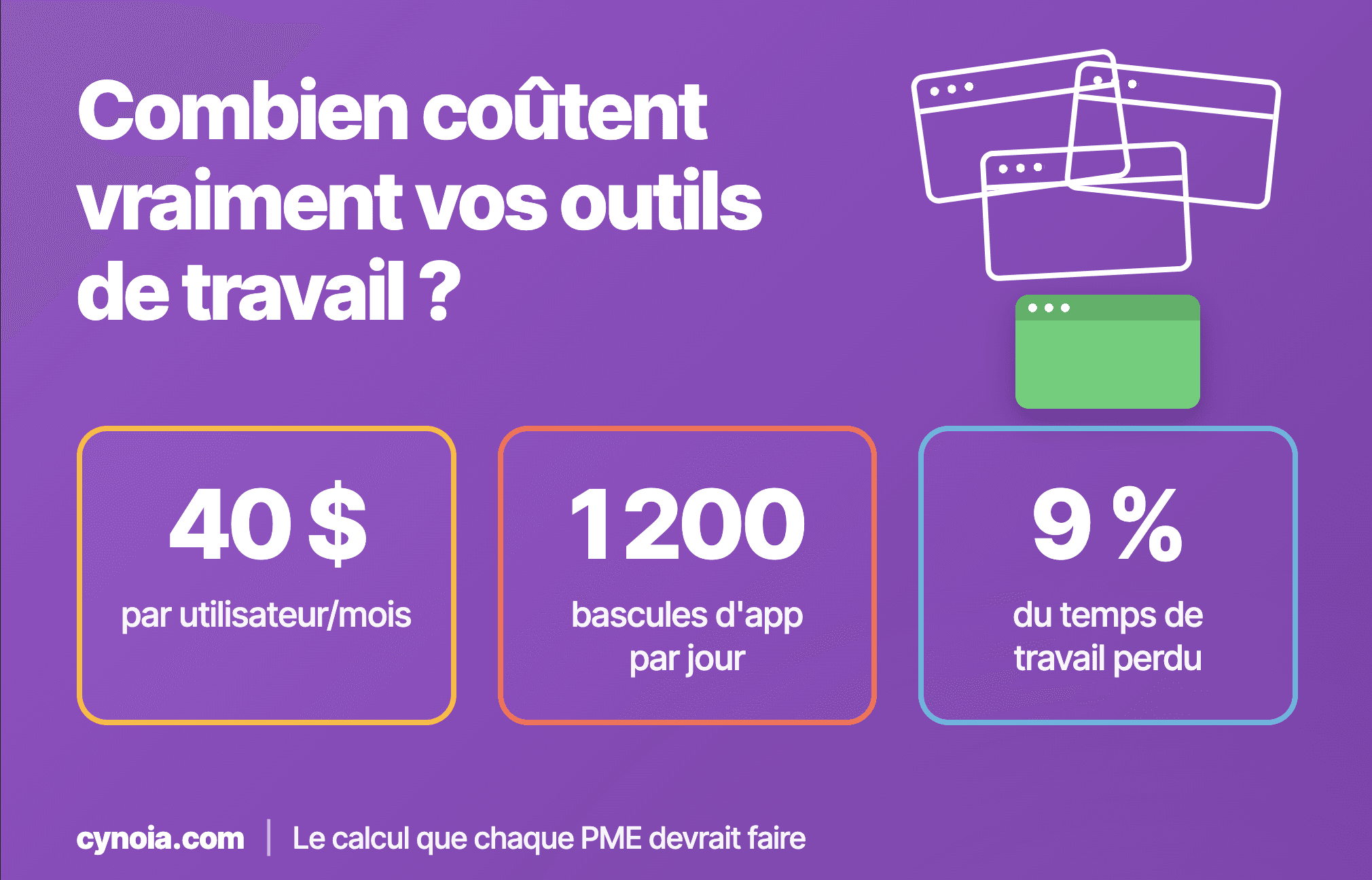
Combien coûtent vraiment vos outils de travail ? Le calcul que chaque PME devrait faire
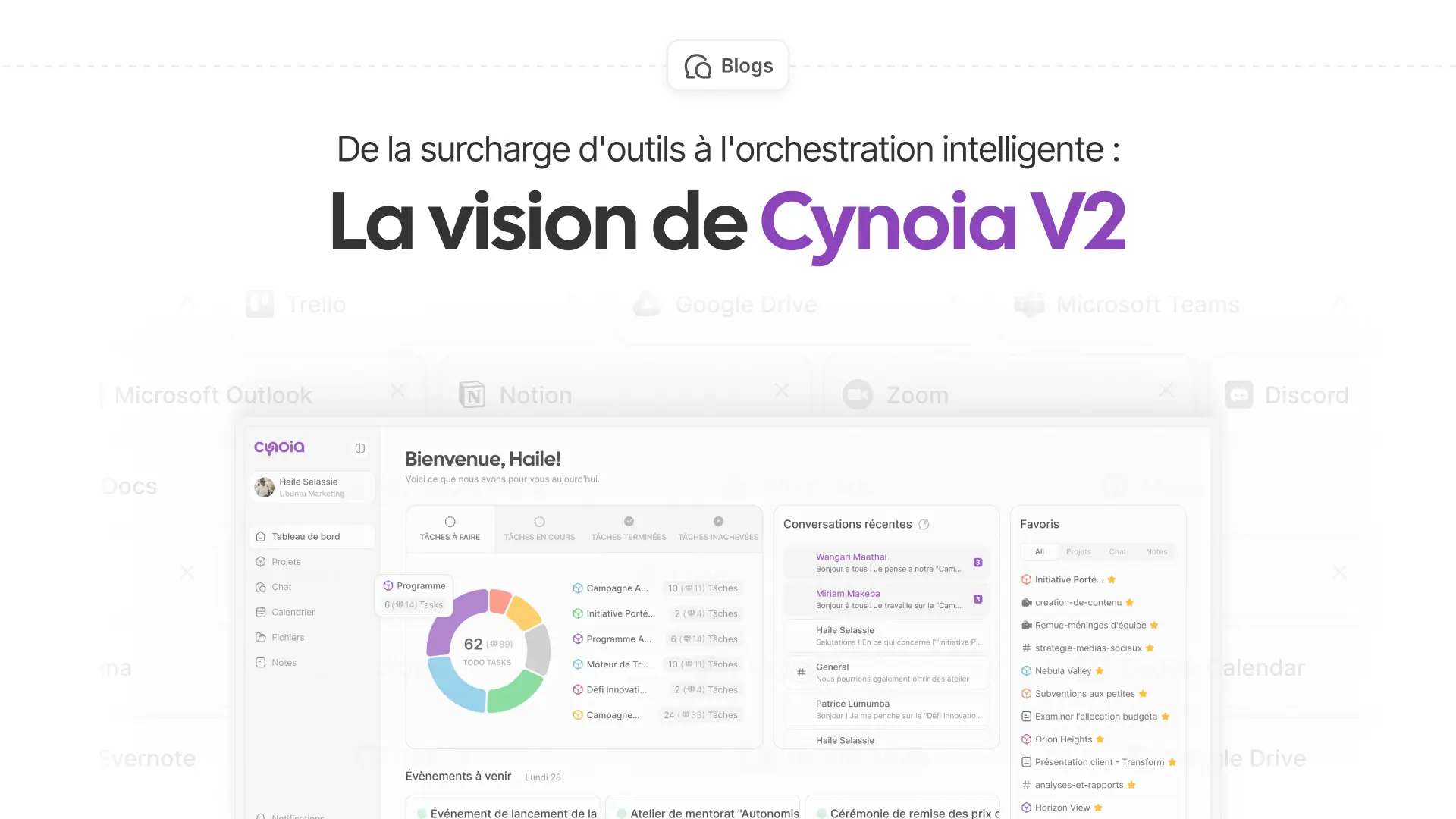
De la Surcharge d'Outils à l'Orchestration Intelligente : La Vision de Cynoia V2
La collaboration digitale en toute confiance : Cynoia, l’allié des équipes africaines
What Do Your Work Tools Really Cost? The Math Every Small Business Should Do
•
Business
The real cost of your collaboration tools never shows up on an invoice. Between stacking subscriptions, the hours your team loses jumping from app to app, and — for African businesses — paying in foreign currency, a 20-person team can quietly spend the equivalent of a full annual salary without ever deciding to.
At Cynoia, we help more than 6,000 users across Africa and Europe consolidate their work tools. Our first piece of advice is always the same: do the math. Here it is, step by step.
Quick Answer
A 20-person team running a typical stack — team messaging, video calls, project management, office suite — pays about $9,600 per year in subscriptions at June 2026 list prices. The hidden cost is bigger: research published in Harvard Business Review found that employees toggle between apps nearly 1,200 times a day — roughly 4 hours per week, or about 9% of annual work time, spent just reorienting.
Quick formula: true cost ≈ annual subscriptions + (headcount × average salary × 9%) + FX and admin fees. In most small businesses, the total far exceeds the "software" line in the budget.
1. What Is SaaS Sprawl?
SaaS sprawl (or tool sprawl) is the unchecked multiplication of software inside a company. One app for chat, another for video meetings, a third for tasks, a fourth for files, a fifth for the calendar. Each was adopted for a good reason; it's the accumulation that hurts.
And it's not just an enterprise problem: companies with 75 to 200 employees use an average of 44 SaaS applications. While large enterprises have started consolidating — the average app portfolio has shrunk 18% since its 2022 peak, according to the Zylo SaaS Management Index — small businesses keep stacking, mostly because nobody has time to audit.
2. Cost #1 — Stacking Subscriptions
Here's a stack we see constantly in small businesses, at June 2026 list prices (annual billing):
Slack Pro (team messaging): $7.25 / user / month
Zoom Pro (video meetings): ≈ $13.33 / user / month
Asana Starter (project management): $10.99 / user / month
Google Workspace Business Starter (email, Drive, Calendar): ≈ $7–8.40 / user / month
Total: ≈ $40 / user / month
For a 20-person team, that's about $9,600 a year — and that figure is a floor. It doesn't count seats you pay for but nobody uses, duplicate tools (two video apps, two storage drives), or the forced plan upgrades that hit every time you outgrow a limit.
3. Cost #2 — The Toggle Tax: Time Lost Between Tools
The biggest cost never appears on any bill. Researchers who tracked how employees actually work — in a study published in Harvard Business Review — measured nearly 1,200 app switches per employee per day. Each switch costs only a couple of seconds. Added up, they consume about 4 hours per week — 9% of annual work time — spent not producing, but reorienting.
Apply that ratio to our 20-person team: 9% of 20 employees' time is nearly two full-time positions absorbed every year by simply navigating between tools. Whatever your salary levels, that cost dwarfs the subscriptions.
On top of the toggle tax comes fragmented attention: a question asked in chat, an answer buried in a task comment, a decision made on a video call and never written down. The information exists — nobody knows where.
4. Cost #3 — The Cost Nobody Writes About: Paying in Foreign Currency
This is the blind spot of every analysis published on this topic. For a business in Dakar, Lagos, Nairobi, or Tunis, subscribing to a US software stack means paying in dollars or euros, with three extra costs every founder knows too well:
International payment fees: FX commissions and bank charges on every monthly debit, multiplied by the number of tools.
Exchange-rate exposure: a SaaS budget approved in January can blow up by Q3 as the local currency moves against the dollar.
Payment access constraints: international card limits, rationed foreign currency, bank approvals — administrative friction repeated for every single vendor.
Cutting the number of vendors that bill in foreign currency isn't just a saving; it's a cash-flow simplification. It's one of the reasons Cynoia was built as a single platform, designed in Africa for African and European teams.
5. Cost #4 — The Invisible Costs: Onboarding, Security, Scattered Knowledge
Three more line items complete the bill — rarely quantified, always real:
Multiplied onboarding: every new hire must be created, trained, and configured on 4 or 5 tools. Every departure must be revoked everywhere — and one forgotten account is a security hole.
A wider risk surface: more tools means more passwords, more privacy policies to vet, more company data scattered across vendors. For organizations handling sensitive data, this becomes a deal-breaker in procurement.
Fragmented knowledge: when decision history is split across a messaging app, comment threads, and meeting recordings, every search for information becomes an investigation.
6. The 4-Step Method to Calculate Your Own Cost
List every collaboration subscription (messaging, video, projects, storage, calendar) — including the ones paid on personal cards and expensed. Note the price per seat and the number of seats paid for. Not used. Paid for.
Compute the annual cost in your local currency, FX fees included if you pay in dollars or euros.
Estimate your toggle tax: headcount × average salary × 9%. It's an approximation, but it gives you the order of magnitude of the hidden cost.
Add a "risk and admin" line: HR/IT time spent managing accounts, duplicate tools you've spotted, incidents tied to unrevoked access.
In most of the small businesses we work with, the total is a surprise: the real cost runs several times higher than the subscriptions alone.
7. Cutting the Bill: Consolidate, Don't Stack
The answer to SaaS sprawl isn't to cut what your team does — they genuinely need to chat, meet, plan, and share files. The answer is to group those needs into the smallest possible number of tools.
That's exactly Cynoia's bet: chat, video conferencing, calendar, file sharing, and project management in one platform, one subscription, one invoice — where information stays where it was created. A conversation becomes a task, a meeting links to the project's documents, and nobody spends four hours a week reassembling the puzzle.
For a 20-person team, replacing the stack above with a unified platform means four times fewer vendors, a smaller subscription bill, and a meaningful share of that 9% of lost time recovered. We covered what this means for young teams in how startups save on software costs, and where we're heading in Cynoia V2: from tool overload to intelligent orchestration.
Ready to run the numbers for your team? Try Cynoia free (10 users, no credit card required) or talk to our team — we'll help you price out your current stack, no strings attached.
FAQ
What is SaaS sprawl?
SaaS sprawl is the unchecked multiplication of software across a company: every team adopts its own tools, subscriptions pile up, and information scatters. Companies with 75–200 employees use an average of 44 SaaS applications.
How much does a typical collaboration stack cost a small business?
At June 2026 list prices, a Slack + Zoom + Asana + Google Workspace stack runs about $40 per user per month — roughly $9,600 a year for a 20-person team, before FX fees and hidden costs.
What is the toggle tax?
The toggle tax is the time lost switching between applications. Research published in Harvard Business Review measured nearly 1,200 switches per employee per day — about 4 hours per week, or 9% of annual work time.
Is consolidating tools risky for a small business?
Check three things before consolidating: that you can export your data at any time, that the platform actually covers your use cases (chat, video, projects, files, calendar), and that it meets your industry's security requirements. A well-chosen unified platform reduces your risk surface rather than increasing it.
Why is paying in foreign currency a real issue for African businesses?
Every subscription billed in dollars or euros adds FX fees, exchange-rate exposure, and banking constraints. Multiplying foreign vendors multiplies that friction; consolidating them cuts it down.
Sources
Harvard Business Review — How Much Time and Energy Do We Waste Toggling Between Applications? (≈ 1,200 switches/day, ≈ 4 h/week, ≈ 9% of annual work time)
Zylo SaaS Management Index (consolidation trend, –18% since the 2022 peak); per-size breakdown: SaaSUltra, May 2026 (44 apps for 75–199 employees)
June 2026 list prices: official Slack, Zoom, Asana, and Google Workspace pricing pages
Écrivez ici
Recherche
Articles récents:
The 8 Best Team Collaboration Tools for African Businesses (2026)
Les 8 meilleurs outils de collaboration pour les entreprises africaines (2026)
Combien coûtent vraiment vos outils de travail ? Le calcul que chaque PME devrait faire
De la Surcharge d'Outils à l'Orchestration Intelligente : La Vision de Cynoia V2
La collaboration digitale en toute confiance : Cynoia, l’allié des équipes africaines
What Do Your Work Tools Really Cost? The Math Every Small Business Should Do
•
Business
The real cost of your collaboration tools never shows up on an invoice. Between stacking subscriptions, the hours your team loses jumping from app to app, and — for African businesses — paying in foreign currency, a 20-person team can quietly spend the equivalent of a full annual salary without ever deciding to.
At Cynoia, we help more than 6,000 users across Africa and Europe consolidate their work tools. Our first piece of advice is always the same: do the math. Here it is, step by step.
Quick Answer
A 20-person team running a typical stack — team messaging, video calls, project management, office suite — pays about $9,600 per year in subscriptions at June 2026 list prices. The hidden cost is bigger: research published in Harvard Business Review found that employees toggle between apps nearly 1,200 times a day — roughly 4 hours per week, or about 9% of annual work time, spent just reorienting.
Quick formula: true cost ≈ annual subscriptions + (headcount × average salary × 9%) + FX and admin fees. In most small businesses, the total far exceeds the "software" line in the budget.
1. What Is SaaS Sprawl?
SaaS sprawl (or tool sprawl) is the unchecked multiplication of software inside a company. One app for chat, another for video meetings, a third for tasks, a fourth for files, a fifth for the calendar. Each was adopted for a good reason; it's the accumulation that hurts.
And it's not just an enterprise problem: companies with 75 to 200 employees use an average of 44 SaaS applications. While large enterprises have started consolidating — the average app portfolio has shrunk 18% since its 2022 peak, according to the Zylo SaaS Management Index — small businesses keep stacking, mostly because nobody has time to audit.
2. Cost #1 — Stacking Subscriptions
Here's a stack we see constantly in small businesses, at June 2026 list prices (annual billing):
Slack Pro (team messaging): $7.25 / user / month
Zoom Pro (video meetings): ≈ $13.33 / user / month
Asana Starter (project management): $10.99 / user / month
Google Workspace Business Starter (email, Drive, Calendar): ≈ $7–8.40 / user / month
Total: ≈ $40 / user / month
For a 20-person team, that's about $9,600 a year — and that figure is a floor. It doesn't count seats you pay for but nobody uses, duplicate tools (two video apps, two storage drives), or the forced plan upgrades that hit every time you outgrow a limit.
3. Cost #2 — The Toggle Tax: Time Lost Between Tools
The biggest cost never appears on any bill. Researchers who tracked how employees actually work — in a study published in Harvard Business Review — measured nearly 1,200 app switches per employee per day. Each switch costs only a couple of seconds. Added up, they consume about 4 hours per week — 9% of annual work time — spent not producing, but reorienting.
Apply that ratio to our 20-person team: 9% of 20 employees' time is nearly two full-time positions absorbed every year by simply navigating between tools. Whatever your salary levels, that cost dwarfs the subscriptions.
On top of the toggle tax comes fragmented attention: a question asked in chat, an answer buried in a task comment, a decision made on a video call and never written down. The information exists — nobody knows where.
4. Cost #3 — The Cost Nobody Writes About: Paying in Foreign Currency
This is the blind spot of every analysis published on this topic. For a business in Dakar, Lagos, Nairobi, or Tunis, subscribing to a US software stack means paying in dollars or euros, with three extra costs every founder knows too well:
International payment fees: FX commissions and bank charges on every monthly debit, multiplied by the number of tools.
Exchange-rate exposure: a SaaS budget approved in January can blow up by Q3 as the local currency moves against the dollar.
Payment access constraints: international card limits, rationed foreign currency, bank approvals — administrative friction repeated for every single vendor.
Cutting the number of vendors that bill in foreign currency isn't just a saving; it's a cash-flow simplification. It's one of the reasons Cynoia was built as a single platform, designed in Africa for African and European teams.
5. Cost #4 — The Invisible Costs: Onboarding, Security, Scattered Knowledge
Three more line items complete the bill — rarely quantified, always real:
Multiplied onboarding: every new hire must be created, trained, and configured on 4 or 5 tools. Every departure must be revoked everywhere — and one forgotten account is a security hole.
A wider risk surface: more tools means more passwords, more privacy policies to vet, more company data scattered across vendors. For organizations handling sensitive data, this becomes a deal-breaker in procurement.
Fragmented knowledge: when decision history is split across a messaging app, comment threads, and meeting recordings, every search for information becomes an investigation.
6. The 4-Step Method to Calculate Your Own Cost
List every collaboration subscription (messaging, video, projects, storage, calendar) — including the ones paid on personal cards and expensed. Note the price per seat and the number of seats paid for. Not used. Paid for.
Compute the annual cost in your local currency, FX fees included if you pay in dollars or euros.
Estimate your toggle tax: headcount × average salary × 9%. It's an approximation, but it gives you the order of magnitude of the hidden cost.
Add a "risk and admin" line: HR/IT time spent managing accounts, duplicate tools you've spotted, incidents tied to unrevoked access.
In most of the small businesses we work with, the total is a surprise: the real cost runs several times higher than the subscriptions alone.
7. Cutting the Bill: Consolidate, Don't Stack
The answer to SaaS sprawl isn't to cut what your team does — they genuinely need to chat, meet, plan, and share files. The answer is to group those needs into the smallest possible number of tools.
That's exactly Cynoia's bet: chat, video conferencing, calendar, file sharing, and project management in one platform, one subscription, one invoice — where information stays where it was created. A conversation becomes a task, a meeting links to the project's documents, and nobody spends four hours a week reassembling the puzzle.
For a 20-person team, replacing the stack above with a unified platform means four times fewer vendors, a smaller subscription bill, and a meaningful share of that 9% of lost time recovered. We covered what this means for young teams in how startups save on software costs, and where we're heading in Cynoia V2: from tool overload to intelligent orchestration.
Ready to run the numbers for your team? Try Cynoia free (10 users, no credit card required) or talk to our team — we'll help you price out your current stack, no strings attached.
FAQ
What is SaaS sprawl?
SaaS sprawl is the unchecked multiplication of software across a company: every team adopts its own tools, subscriptions pile up, and information scatters. Companies with 75–200 employees use an average of 44 SaaS applications.
How much does a typical collaboration stack cost a small business?
At June 2026 list prices, a Slack + Zoom + Asana + Google Workspace stack runs about $40 per user per month — roughly $9,600 a year for a 20-person team, before FX fees and hidden costs.
What is the toggle tax?
The toggle tax is the time lost switching between applications. Research published in Harvard Business Review measured nearly 1,200 switches per employee per day — about 4 hours per week, or 9% of annual work time.
Is consolidating tools risky for a small business?
Check three things before consolidating: that you can export your data at any time, that the platform actually covers your use cases (chat, video, projects, files, calendar), and that it meets your industry's security requirements. A well-chosen unified platform reduces your risk surface rather than increasing it.
Why is paying in foreign currency a real issue for African businesses?
Every subscription billed in dollars or euros adds FX fees, exchange-rate exposure, and banking constraints. Multiplying foreign vendors multiplies that friction; consolidating them cuts it down.
Sources
Harvard Business Review — How Much Time and Energy Do We Waste Toggling Between Applications? (≈ 1,200 switches/day, ≈ 4 h/week, ≈ 9% of annual work time)
Zylo SaaS Management Index (consolidation trend, –18% since the 2022 peak); per-size breakdown: SaaSUltra, May 2026 (44 apps for 75–199 employees)
June 2026 list prices: official Slack, Zoom, Asana, and Google Workspace pricing pages
Écrivez ici
Recherche
Articles récents:
The 8 Best Team Collaboration Tools for African Businesses (2026)
Les 8 meilleurs outils de collaboration pour les entreprises africaines (2026)
Combien coûtent vraiment vos outils de travail ? Le calcul que chaque PME devrait faire
De la Surcharge d'Outils à l'Orchestration Intelligente : La Vision de Cynoia V2
La collaboration digitale en toute confiance : Cynoia, l’allié des équipes africaines
Derniers articles
Discover other pieces of writing in our blog
Simplifiez vos projets dès aujourd'hui
Aucune carte bancaire n'est requise | 10 utilisateurs gratuits | Configuration 3 min
Simplifiez vos projets dès aujourd'hui
Aucune carte bancaire n'est requise | 10 utilisateurs gratuits | Configuration 3 min
Simplifiez vos projets dès aujourd'hui
Aucune carte bancaire n'est requise | 10 utilisateurs gratuits | Configuration 3 min